Markets in Transition: Geopolitics, AI Anxiety, and the Power of Discipline
This month has been dominated by a major geopolitical development.
In February, joint U.S. and Israeli strikes on Iran resulted in the death of Iran’s supreme leader and several top military officials. Iran has since retaliated with attacks on U.S. bases in the region and against Israel. Political reactions in Washington have been sharply divided, adding another layer of uncertainty for investors.
Whenever geopolitical risk rises, markets react. But the more important story right now is what is happening beneath the surface.
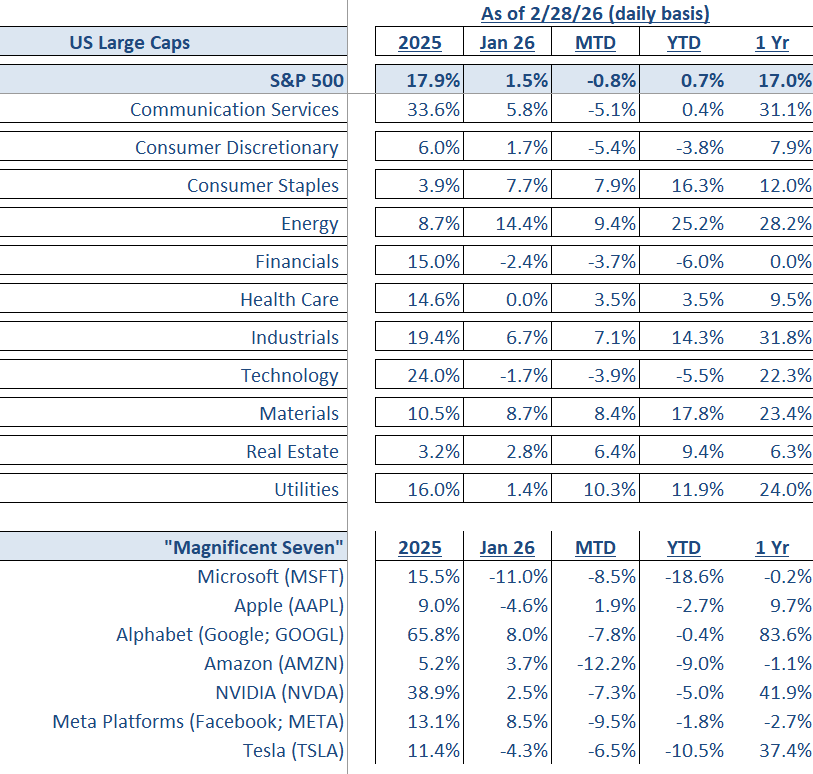
Year to date, the S&P 500 is up just 0.7%. That headline number hides a significant rotation. Leadership has shifted away from the high P/E Magnificent Seven and hyperscale technology stocks and into lower valuation sectors.
Energy is up over 25% this year. Materials are up nearly 18%. Consumer Staples are up 16%. Industrials are up 14%. Even rate sensitive sectors like Utilities and Real Estate are performing well as interest rates have declined.
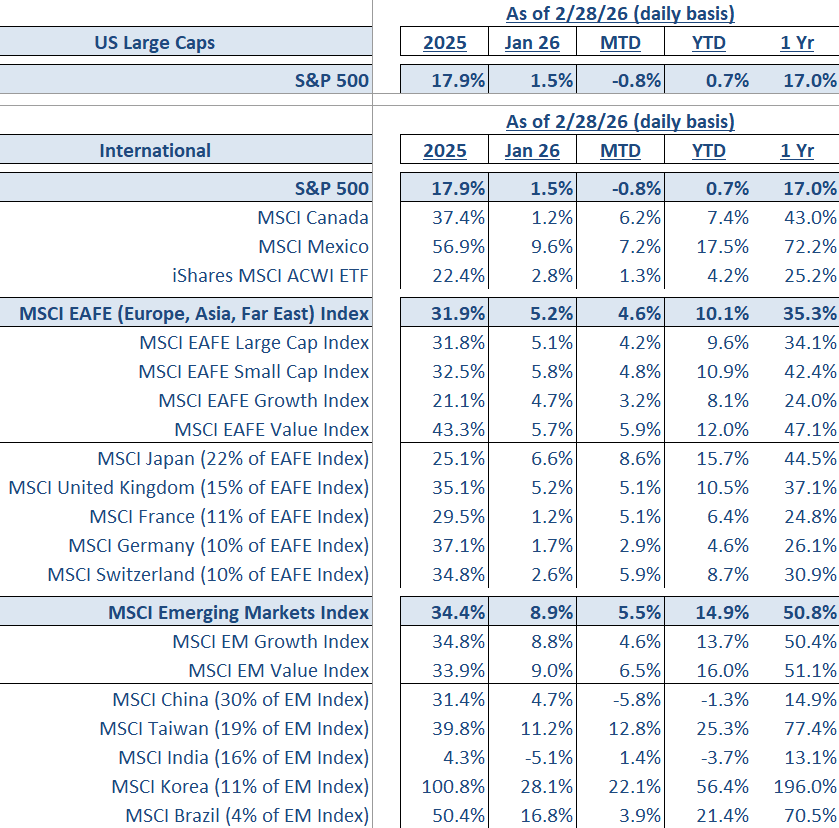
International markets continue to outperform the U.S. Developed international stocks are up over 10%, and emerging markets are up nearly 15%, led by very strong gains in South Korea and Taiwan.
At the same time, there is growing anxiety around artificial intelligence. Investors are questioning whether asset light, high margin technology and software companies can maintain their dominance. Concerns about AI driven job displacement are spreading, and even private credit markets are being scrutinized due to exposure to software and technology borrowers.
There is a lot of fear in the narrative right now. But here is what the data says:
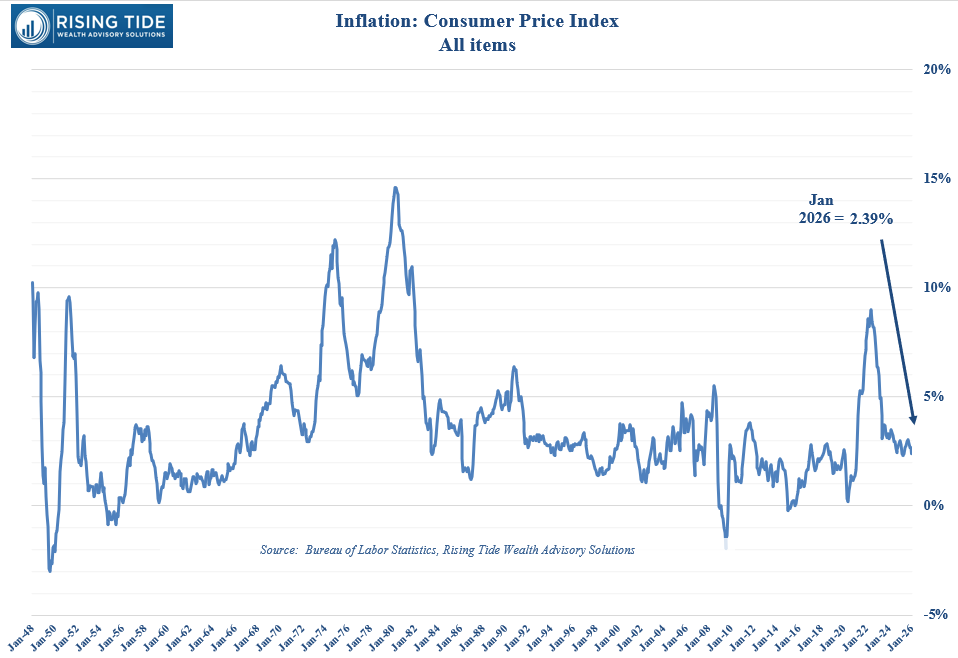
The economy continues to expand. The labor market remains stable. Inflation has fallen to 2.4% and continues to move toward the Fed’s 2% target. Bonds are positive for the year. Commodities are strong. Even with volatility, diversification is working.
Periods like this feel uncomfortable. They always do. But volatility is normal. It is the price we pay for long term returns.
We cannot time geopolitical events. We cannot predict short term market swings. What we can do is stay disciplined, maintain strategic allocations, rebalance when appropriate, and use volatility to our advantage.
Fear is temporary. As always, we suggest staying diversified, invested, and focused on the long term.
Disclosures:
Unless otherwise specified, all performance references for any index or investment reflect total return, which includes price changes, interest and dividends, and are quoted in US dollar returns. Unspecified indices include: “Value stocks” = Russell 1000 Value Index; “Growth stocks” = Russell 1000 Growth Index; “Large cap stocks” = S&P 500; “Midcap stocks” = Russell Midcap Index; “Small cap stocks” = Russell 2000 Index; individual sectors = the respective sector indices within the S&P 500; “US dollar” = Federal Reserve Bank of St. Louis’ Broad Trade Weighted US Dollar Index; “International Developed Market Stocks” = MSCI EAFE (Europe, Asia, Far East) Index; “International Emerging Market Stocks” = MSCI Emerging Markets Index; individual countries = the respective country indices produced by MSCI; “Short-term bonds” = Bloomberg US Govt/Credit 1-3 Yr Index; “Long-term bonds” = Bloomberg US Long Govt/Credit Float Adjusted Index; “Treasury bonds” = Bloomberg US Treasury Index; “Corporate bonds” = Bloomberg US Corporate Bond Index; “High yield bonds” = Bloomberg US Corporate High Yield Index; “Emerging market bonds” = Bloomberg EM Debt USD Aggregate Index; real estate sector indices = the respective sector indices within the FTSE NAREIT REITs Indices.
Index and investment figures quoted come from Morningstar Direct. Past performance is no indication of future results. You cannot invest directly in an index. Investment in securities involves significant risk and has the potential for partial or complete loss of funds invested. It should not be assumed that any recommendations made will be profitable or equal the performance noted in this publication.
Rising Tide Wealth Advisory Solutions, LLC (“RTWAS”) is a registered investment advisor offering advisory services in the State of Missouri and in other jurisdictions where exempted. Registration does not imply a certain level of skill or training.
This communication is for informational purposes only and is not intended as tax, accounting or legal advice, as an offer or solicitation of an offer to buy or sell, or as an endorsement of any company, security, fund, or other securities or non-securities offering. This communication should not be relied upon as the sole factor in an investment making decision.
The information herein is provided “AS IS” and without warranties of any kind either express or implied. To the fullest extent permissible pursuant to applicable laws, Rising Tide Wealth Advisory Solutions, LLC disclaims all warranties, express or implied, including, but not limited to, implied warranties of merchantability, non-infringement, and suitability for a particular purpose.
All opinions and estimates constitute RTWAS’s judgement as of the date of this communication and are subject to change without notice. RTWAS does not warrant that the information will be free from error. The information should not be relied upon for purposes of transacting securities or other investments. Your use of the information is at your sole risk. Under no circumstances shall RTWAS be liable for any direct, indirect, special or consequential damages that result from the use of, or the inability to use, the information provided herein, even if RTWAS or a RTWAS authorized representative has been advised of the possibility of such damages. Information contained herein should not be considered a solicitation to buy, an offer to sell, or a recommendation of any security in any jurisdiction where such offer, solicitation, or recommendation would be unlawful or unauthorized.